

The Future of Remote Work in UAE: Building Productive Hybrid Teams
The UAE workplace has undergone a profound transformation. What began as an emergency response to the COVID-19 pandemic has evolved into a permanent shift in how organizations structure work and engage employees. Today, remote work in UAE is no longer a temporary accommodation but a strategic business imperative, with hybrid work models becoming the dominant workplace arrangement across industries. For business leaders, HR professionals, and entrepreneurs, understanding how to build and manage productive hybrid teams has become essential for organizational success and competitive advantage.
The statistics underscore this transformation. A 2024 survey of UAE businesses found that 68% of organizations now operate hybrid work models, with 42% offering fully flexible remote work arrangements. The UAE government has actively supported this shift, with the Ministry of Human Resources and Emiratization establishing guidelines for flexible work arrangements and the Dubai Municipality creating frameworks supporting remote work adoption. The market evidence is clear: organizations embracing hybrid work models report 34% higher employee productivity, 28% improvement in employee retention, and 22% reduction in real estate costs. These metrics demonstrate that hybrid work is not merely an employee benefit but a strategic business advantage.
This article examines the evolution of remote work in UAE, provides practical frameworks for building productive hybrid teams, and explores the strategic opportunities and challenges organizations must navigate in this new workplace reality.
The Evolution of Remote Work in the UAE
The UAE’s journey toward remote work adoption reflects broader global trends but with distinctly local characteristics shaped by the Emirates’ business culture, regulatory environment, and economic priorities. Understanding this evolution provides context for current hybrid work practices and future workplace strategies.
Before the pandemic, the UAE workplace was predominantly traditional and office-centric. The business culture emphasized in-person collaboration, face-to-face meetings, and physical presence as indicators of commitment and productivity. Remote work was rare, typically limited to specific roles or circumstances, and often viewed with skepticism by traditional business leaders. The UAE’s rapid economic growth and competitive business environment created a culture where visible presence in the office was equated with professional dedication.
The COVID-19 pandemic fundamentally disrupted this paradigm. When lockdowns forced businesses to transition to remote work virtually overnight, many UAE organizations discovered that their operations could function effectively—and in some cases, more efficiently—with distributed teams. Employees working from home reported reduced commute times, fewer office distractions, and improved focus on complex tasks. Organizations discovered that remote work enabled them to access talent beyond geographic boundaries, reducing their dependence on Dubai and Abu Dhabi’s competitive labor markets. The pandemic became an unintended experiment demonstrating remote work’s viability in the UAE context.
As pandemic restrictions eased, UAE organizations faced a critical choice: return to traditional office-based work or embrace the hybrid models they had developed. Most chose a middle path, implementing hybrid arrangements that combined remote work flexibility with periodic office presence. This decision reflected both employee preferences—surveys showed 71% of UAE workers preferred hybrid arrangements—and organizational recognition of hybrid work’s business benefits. The transition was not without challenges, as some business leaders struggled with managing distributed teams and maintaining organizational culture, but the overall trajectory has been toward increased remote work adoption.
The UAE government has actively supported this workplace evolution. In 2021, the Ministry of Human Resources and Emiratization issued guidelines establishing the legal framework for remote work arrangements, clarifying employment rights and responsibilities for both employers and employees. The Dubai Municipality created a “Smart Working” initiative supporting businesses in implementing flexible work arrangements. The Abu Dhabi Department of Human Resources established innovation labs exploring future workplace models. These government initiatives created a supportive regulatory environment encouraging organizations to experiment with and adopt remote work practices.
Today, remote work in UAE is mainstream across most industries and organization sizes. Financial services firms, technology companies, consulting firms, and even traditional industries have embraced hybrid models. The adoption varies by industry—technology companies lead with 78% hybrid adoption, while manufacturing and hospitality lag at 32%—but the overall trend is clear. The future of work in the UAE is hybrid, flexible, and distributed.
Understanding Hybrid Work Models – Benefits and Challenges
Hybrid work encompasses diverse arrangements, from flexible schedules allowing employees to work remotely certain days while maintaining office presence, to fully distributed teams with minimal office requirements. Understanding the different hybrid models and their implications is essential for organizations designing workplace strategies aligned with their business needs and employee preferences.
The most common hybrid model in the UAE is the structured hybrid arrangement, where employees work in the office specific days (typically 2-3 days weekly) and remotely on other days. This model provides regular in-person collaboration opportunities while preserving remote work flexibility. Another prevalent model is the flexible hybrid arrangement, where employees and managers negotiate work location arrangements based on role requirements and personal preferences. A third model is the role-based hybrid arrangement, where some roles require regular office presence (client-facing positions, roles requiring specialized equipment) while others operate fully remotely.
The benefits of hybrid work models for organizations are substantial and well-documented. Productivity improvements represent the most significant advantage. Employees working remotely on focused tasks report 35-40% productivity improvements compared to office environments with constant interruptions. Hybrid arrangements enable this by allowing employees to allocate specific days for deep work and collaboration days for meetings and team interaction. Cost reduction is another major benefit. Organizations implementing hybrid models report 20-30% reduction in real estate costs through reduced office space requirements, lower utilities consumption, and decreased facility management expenses. For UAE organizations where premium real estate costs are substantial, these savings are significant.
Talent acquisition and retention improvements represent strategic advantages of hybrid work. By offering remote work flexibility, organizations can access talent beyond geographic boundaries, competing for skilled professionals globally rather than being limited to Dubai and Abu Dhabi labor markets. This expanded talent pool enables organizations to hire specialized expertise that may be unavailable locally. Retention improves as employees value work-life balance and flexibility; organizations offering hybrid arrangements report 25-35% improvement in retention rates compared to traditional office-only arrangements.
However, hybrid work models present significant challenges that organizations must actively manage. The primary challenge is maintaining team cohesion and organizational culture in distributed environments. When team members work remotely, spontaneous interactions decrease, informal knowledge transfer diminishes, and organizational culture becomes more difficult to cultivate. Managers report that building trust and accountability in hybrid teams requires more intentional effort than in traditional office settings. Communication becomes more complex, as asynchronous communication (email, messaging) supplements synchronous interaction (meetings, in-person collaboration), creating potential for miscommunication and misalignment.
Performance management in hybrid environments presents another challenge. Traditional performance metrics based on visible presence and time in office become obsolete, requiring organizations to develop outcome-based performance management systems. Managers must learn to evaluate employee performance based on results and deliverables rather than observable activity. This transition requires significant change in management mindset and capability development for many UAE business leaders accustomed to traditional management approaches.
Equity and fairness concerns emerge in hybrid environments. Employees working remotely full-time may feel disadvantaged compared to those maintaining office presence, particularly regarding career advancement and visibility to leadership. Organizations must establish clear policies ensuring that remote workers have equal access to opportunities, mentorship, and career development as office-based employees.
Technology Infrastructure for Hybrid Workplaces
Successful hybrid work implementation requires robust technology infrastructure enabling seamless collaboration, secure data access, and effective communication across distributed teams. The technology foundation determines whether hybrid work enhances or hinders organizational productivity and effectiveness.
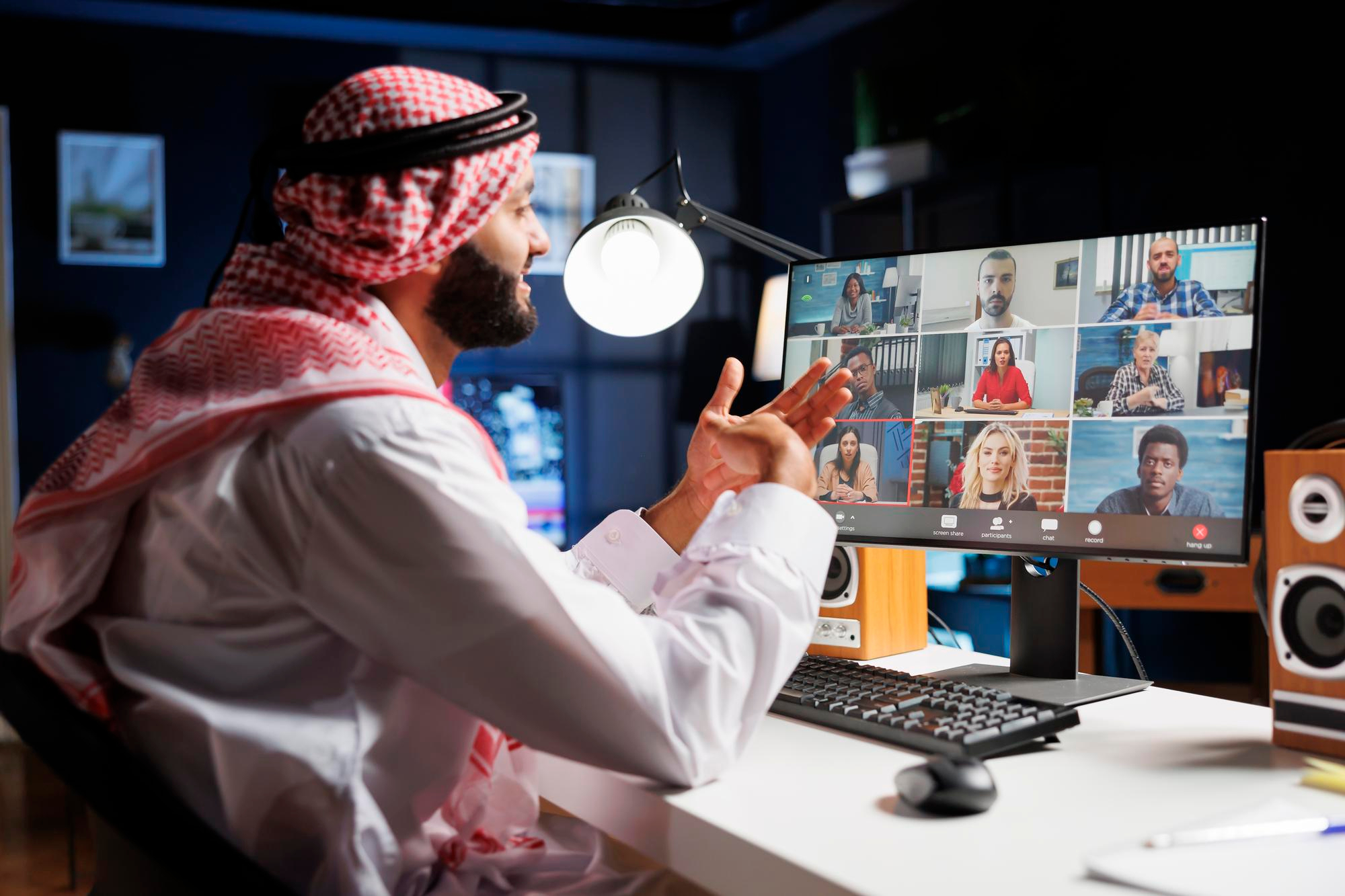
The essential technology stack for hybrid workplaces includes communication platforms enabling real-time interaction across distributed teams. Video conferencing tools like Microsoft Teams, Zoom, and Google Meet have become ubiquitous, enabling face-to-face interaction regardless of location. However, organizations must ensure these tools integrate with their existing systems and support their specific collaboration needs. Asynchronous communication platforms like Slack and Microsoft Teams enable ongoing conversation and knowledge sharing that doesn’t require real-time participation, accommodating different time zones and work schedules.
Collaboration and project management tools are equally essential. Platforms like Asana, Monday.com, and Microsoft Project enable teams to coordinate work, track progress, and maintain transparency regarding project status and individual responsibilities. These tools create visibility that would naturally occur in office environments but requires intentional technology support in hybrid settings. Document collaboration platforms like Google Workspace and Microsoft 365 enable multiple team members to work simultaneously on shared documents, eliminating version control issues and enabling real-time collaboration.
Cybersecurity and data protection become increasingly critical in hybrid environments where employees access company systems from various locations and devices. Organizations must implement robust security measures including virtual private networks (VPNs) for secure remote access, multi-factor authentication preventing unauthorized access, and endpoint protection securing employee devices. The complexity of securing distributed systems requires investment in security infrastructure and employee training. Many UAE organizations have underestimated cybersecurity requirements for hybrid work, creating vulnerabilities that sophisticated attackers exploit.
Integration and scalability considerations are paramount. Organizations must ensure that new collaboration tools integrate seamlessly with existing enterprise systems, avoiding fragmented technology landscapes where data and communication are scattered across incompatible platforms. Scalability is essential as organizations grow or adjust their hybrid work strategies; technology infrastructure must support growth without requiring complete replacement or major redesign.
The technology investment required for robust hybrid work infrastructure is substantial but essential. Organizations attempting to implement hybrid work with inadequate technology typically experience poor collaboration, security vulnerabilities, and employee frustration. Conversely, organizations investing in comprehensive technology infrastructure and providing adequate training report significantly higher hybrid work success rates.
Managing Remote and Hybrid Teams – Practical Strategies
Successfully managing distributed teams requires fundamentally different approaches than traditional office management. Managers must develop new skills and adopt different mindsets to lead effectively in hybrid environments where visibility is limited and spontaneous interaction is reduced.
The foundation of effective hybrid team management is clear communication and expectation setting. Managers must explicitly communicate expectations regarding work location, availability, response times, and collaboration norms. In office environments, these expectations are often implicit and absorbed through observation; in hybrid settings, they must be explicit and documented. Successful managers establish clear communication protocols specifying when synchronous interaction is required versus when asynchronous communication is appropriate, which meetings require in-person attendance versus video participation, and how the team will maintain alignment and coordination.
Trust and accountability form the second pillar of effective hybrid team management. Managers must shift from activity-based evaluation (observing employees working) to outcome-based evaluation (assessing results and deliverables). This requires establishing clear goals, defining success metrics, and regularly assessing progress against objectives. Managers must trust employees to manage their time and work location effectively while maintaining accountability for results. This balance is challenging for many managers accustomed to traditional management approaches but is essential for hybrid work success.
Remote and hybrid workers can leverage QR-enabled digital business cards to maintain professional networking efficiency despite distributed work arrangements, enabling instant contact information sharing across virtual meetings, video conferences, and occasional in-person gatherings without relying on traditional paper business cards. By implementing QR vCard solutions, remote professionals can present a modern, technology-forward professional image while streamlining contact information exchange, supporting relationship building in hybrid work environments where spontaneous networking opportunities are reduced compared to traditional office settings.
Building team cohesion and maintaining culture in hybrid environments requires intentional effort. Managers should schedule regular team meetings combining business updates with informal interaction and relationship building. Some organizations implement “office days” where the entire team works in-office simultaneously, creating opportunities for in-person collaboration and social connection. Others use quarterly in-person team retreats combining business planning with team building and relationship development. The specific approach matters less than the intentionality of maintaining team cohesion despite distributed work arrangements.
One-on-one meetings become more important in hybrid environments, providing opportunities for individual connection, career development discussion, and informal feedback. Managers should increase the frequency of one-on-ones with remote team members compared to office-based employees, ensuring they maintain strong relationships and provide adequate support. These conversations should address not only work performance but also employee wellbeing, career aspirations, and any challenges related to remote work.
Performance management in hybrid environments requires outcome-based metrics rather than activity-based evaluation. Managers should establish clear objectives, define measurable success criteria, and regularly assess progress. This approach is more objective and fair than activity-based evaluation and aligns with hybrid work’s emphasis on results rather than presence. However, it requires more discipline and structure than traditional management approaches.
Employee Engagement and Culture Building in Remote Teams
Maintaining strong employee engagement and organizational culture in hybrid environments represents one of the most significant challenges organizations face. The informal interactions that naturally build culture in office environments—hallway conversations, lunch discussions, spontaneous collaboration—don’t occur in distributed settings, requiring organizations to intentionally design engagement and culture-building activities.
The first challenge is maintaining connection to organizational purpose and values. In office environments, employees absorb organizational culture through daily interaction with colleagues and leadership. In hybrid settings, this cultural transmission becomes less automatic, requiring organizations to more explicitly communicate purpose, values, and cultural expectations. Successful organizations use multiple channels—company newsletters, town halls, team meetings, and one-on-one conversations—to reinforce organizational culture and ensure employees understand how their work contributes to organizational mission.
Remote employee engagement requires intentional programming. Many organizations implement virtual team building activities—online games, virtual happy hours, online fitness classes—designed to create social connection despite physical distance. While these activities have value, research suggests they are most effective when supplemented with in-person interaction. Organizations that combine regular virtual engagement with periodic in-person gatherings report significantly higher engagement than those relying solely on virtual activities.
Career development and growth opportunities must be explicitly designed in hybrid environments. In traditional office settings, informal mentorship and exposure to leadership create career development opportunities; in hybrid settings, these must be formalized. Successful organizations establish mentorship programs pairing junior employees with experienced colleagues, create structured career development conversations, and ensure remote employees have equal access to growth opportunities as office-based colleagues. Without intentional design, remote employees often experience reduced career development and advancement opportunities, creating retention risks.
Recognition and celebration of achievements become more important in hybrid environments where informal recognition is less frequent. Organizations should implement formal recognition programs acknowledging individual and team achievements. Celebrating milestones—project completions, promotions, work anniversaries—in team meetings and communications reinforces culture and maintains engagement.
Remote workers and distributed teams depend on professional graphic design to establish consistent visual identity and credible professional presence across digital communication channels, from email signatures and video conference backgrounds to personal websites and social media profiles that represent them in virtual work environments. By investing in professional graphic design services for personal branding materials, remote professionals can create cohesive visual identity that enhances credibility, supports career advancement, and differentiates them in competitive job markets where digital presentation is the primary basis for professional judgment.
Productivity Optimization in Hybrid Work Environments
Maximizing productivity in hybrid environments requires understanding how work patterns change with distributed arrangements and implementing strategies to optimize productivity while maintaining employee wellbeing.
Measuring productivity in hybrid environments is more complex than in traditional office settings where activity is visible. Organizations must develop outcome-based productivity metrics focused on deliverables, project completion, and goal achievement rather than activity metrics like hours worked or time in office. Key productivity indicators might include project completion rates, quality metrics, customer satisfaction scores, and individual goal achievement. These metrics provide objective assessment of productivity independent of work location.
Creating conducive work environments is essential for remote productivity. Employees working from home require adequate space, appropriate furniture, reliable internet connectivity, and minimal distractions. Organizations should provide guidance and potentially financial support for home office setup, recognizing that employee productivity depends on adequate work environment. Some organizations provide home office stipends enabling employees to purchase necessary equipment and furniture.
Time management and work-life balance become critical in hybrid environments where the boundary between work and personal life becomes blurred. Employees working from home often struggle to “switch off” from work, leading to extended work hours and burnout. Organizations should establish norms regarding working hours, encourage employees to maintain clear boundaries between work and personal time, and model healthy work-life balance through leadership behavior. Managers should discourage after-hours communication and respect employee time off.
Preventing burnout and maintaining wellness is essential in hybrid environments where isolation and boundary blurring create burnout risks. Organizations should implement wellness programs addressing physical health (fitness programs, ergonomic support), mental health (counseling services, stress management resources), and social connection (team building, community engagement). Regular check-ins with employees regarding workload and wellbeing enable managers to identify burnout risks early and implement interventions.
Attracting and Retaining Talent Through Flexible Work
Hybrid work arrangements have become a significant competitive advantage in talent acquisition and retention. Organizations offering flexible work attract higher-quality talent and experience improved retention compared to those maintaining traditional office-only arrangements.
The talent market has fundamentally shifted. Employees increasingly expect workplace flexibility and view remote work options as essential benefits. A 2024 survey found that 64% of UAE job seekers consider remote work flexibility a critical factor in job selection, with many willing to accept lower compensation in exchange for flexibility. This shift reflects broader changes in employee values, with work-life balance and flexibility becoming increasingly important relative to compensation alone.
In hybrid and remote work environments where spontaneous visibility and informal networking opportunities are limited, remote professionals must proactively build and communicate their personal brands through strategic online presence, consistent visual identity, and compelling professional narratives that establish credibility and differentiate them from peers. By developing a clear personal brand statement, maintaining professional digital profiles, and actively engaging in online professional communities, remote workers can overcome the visibility challenges inherent in distributed arrangements and create career advancement opportunities equivalent to those available in traditional office settings.
Organizations offering hybrid work arrangements access a substantially larger talent pool. By removing geographic constraints, organizations can recruit globally, accessing specialized expertise unavailable in local markets. This expanded talent pool enables organizations to hire higher-quality candidates and build more diverse teams. For UAE organizations competing for specialized talent in technology, finance, and professional services, this geographic flexibility is a significant competitive advantage.
Retention improvements from hybrid work are substantial. Employees value flexibility and autonomy, and organizations offering these benefits experience significantly lower turnover. The cost of replacing an employee—including recruitment, training, and productivity loss—typically equals 50-200% of annual salary, making retention improvements highly valuable. Organizations offering hybrid work report 25-35% improvement in retention rates, representing substantial cost savings and organizational stability.
Compensation and benefits considerations are important in hybrid work contexts. While some organizations reduce compensation for remote workers, this approach risks losing top talent and creates equity concerns. Most successful organizations maintain compensation parity regardless of work location, recognizing that location doesn’t determine employee value or productivity. However, some organizations adjust benefits based on location—for example, providing office-based employees with parking and meal benefits while providing remote workers with home office stipends.
Overcoming Challenges in Hybrid Work Implementation
Despite hybrid work’s benefits, organizations implementing these models face significant challenges requiring active management and strategic solutions.
The primary challenge is maintaining organizational culture and team cohesion in distributed environments. The informal interactions that naturally build culture in offices don’t occur remotely, requiring intentional culture-building efforts. Organizations must explicitly communicate values, celebrate achievements, and create opportunities for social connection. Some organizations implement mandatory office days ensuring regular in-person interaction. Others use quarterly retreats or annual conferences bringing distributed teams together. The specific approach matters less than the intentionality of maintaining culture despite distributed arrangements.
Change management and employee resistance represent another significant challenge. Employees accustomed to traditional office work may resist hybrid arrangements, fearing reduced career advancement or preferring office-based social interaction. Managers may resist hybrid models, viewing remote work as reducing their control and visibility. Organizations must actively manage this resistance through clear communication regarding hybrid work benefits, training for managers on hybrid team management, and pilot programs enabling employees and managers to experience hybrid work before full implementation.
Technical and operational challenges include ensuring adequate technology infrastructure, maintaining cybersecurity, and managing IT support for distributed employees. Organizations must invest in robust technology platforms, provide adequate training, and establish support systems enabling employees to work effectively from various locations. The complexity of supporting distributed technology environments often exceeds organizations’ initial expectations.
Regulatory and compliance considerations are important, particularly regarding employment law, tax implications, and data protection. UAE employment law has evolved to support remote work, but organizations must ensure compliance with regulations regarding working hours, benefits, and employment rights. Tax implications vary depending on employee location and employment arrangement, requiring careful planning. Data protection regulations require organizations to implement security measures protecting employee and company data in distributed environments.
The Future of Work in UAE – Strategic Roadmap
The future of work in the UAE will likely involve continued evolution toward greater flexibility and distributed team models, driven by technological advancement, changing employee expectations, and organizational recognition of hybrid work’s business benefits.
Emerging trends suggest continued movement toward greater workplace flexibility. The concept of “location flexibility” is evolving beyond simple remote work to encompass more sophisticated arrangements where employees can work from multiple locations—home, office, coworking spaces, client sites—based on task requirements and personal preferences. This flexibility requires robust technology infrastructure and strong management practices but enables organizations to optimize productivity and employee satisfaction.
The UAE government’s strategic initiatives support continued workplace evolution. The “UAE Vision 2030” includes workplace flexibility as a component of economic diversification and quality of life improvement. Government initiatives supporting innovation in workplace arrangements, regulatory frameworks enabling flexible work, and investment in digital infrastructure create an enabling environment for continued hybrid work adoption.
Industry-specific adaptations will continue evolving as organizations learn which roles and functions work effectively in remote environments and which require office presence. Technology companies will likely maintain high remote work adoption, while industries requiring hands-on work or client interaction will maintain higher office presence requirements. The most successful organizations will develop nuanced strategies tailoring work arrangements to specific role requirements rather than applying uniform policies.
Long-term organizational strategy must incorporate workplace flexibility as a core element. Organizations that view hybrid work as temporary accommodation rather than strategic advantage will struggle to attract and retain talent as competitors offer greater flexibility. Forward-thinking organizations are redesigning office spaces to emphasize collaboration and team interaction rather than individual workstations, recognizing that office presence should be purposeful rather than default.
Conclusion
The future of remote work in UAE is not a return to pre-pandemic office-centric arrangements but continued evolution toward flexible, distributed work models that balance organizational needs with employee preferences. Organizations that successfully build productive hybrid teams will gain significant competitive advantages in talent acquisition, retention, productivity, and cost efficiency. Those that resist this evolution will find themselves increasingly disadvantaged in competing for talent and delivering organizational results.
Building productive hybrid teams requires intentional effort across multiple dimensions: establishing clear communication and expectations, implementing robust technology infrastructure, developing managers’ hybrid leadership capabilities, maintaining organizational culture and employee engagement, and actively managing the challenges and transitions inherent in hybrid work implementation. The organizations succeeding in this transformation are those viewing hybrid work not as a necessary accommodation but as a strategic opportunity to reimagine work, improve productivity, and enhance employee satisfaction.
The UAE’s progressive regulatory environment, robust technology infrastructure, and business culture increasingly embracing innovation create an exceptional environment for hybrid work adoption and evolution. Organizations embracing this opportunity position themselves for success in the future of work. For entrepreneurs and business leaders seeking to build organizations aligned with modern workplace expectations and employee preferences, hybrid work is not optional but essential. For employees seeking organizations valuing flexibility, autonomy, and results-based evaluation, the hybrid work revolution offers unprecedented opportunity to shape their work experience.
The time to embrace hybrid work is now. The competitive advantages are substantial, the employee demand is clear, and the technology infrastructure is mature. Organizations that delay hybrid work adoption risk losing talent to competitors offering greater flexibility and positioning themselves as outdated in an increasingly modern workplace landscape.
The future of work in the UAE is hybrid, flexible, and distributed. Organizations that successfully navigate this transformation will thrive; those that resist will find themselves increasingly marginalized. The opportunity is substantial, the time is now, and the imperative is clear: build productive hybrid teams, embrace workplace flexibility, and position your organization for success in the future of work.
